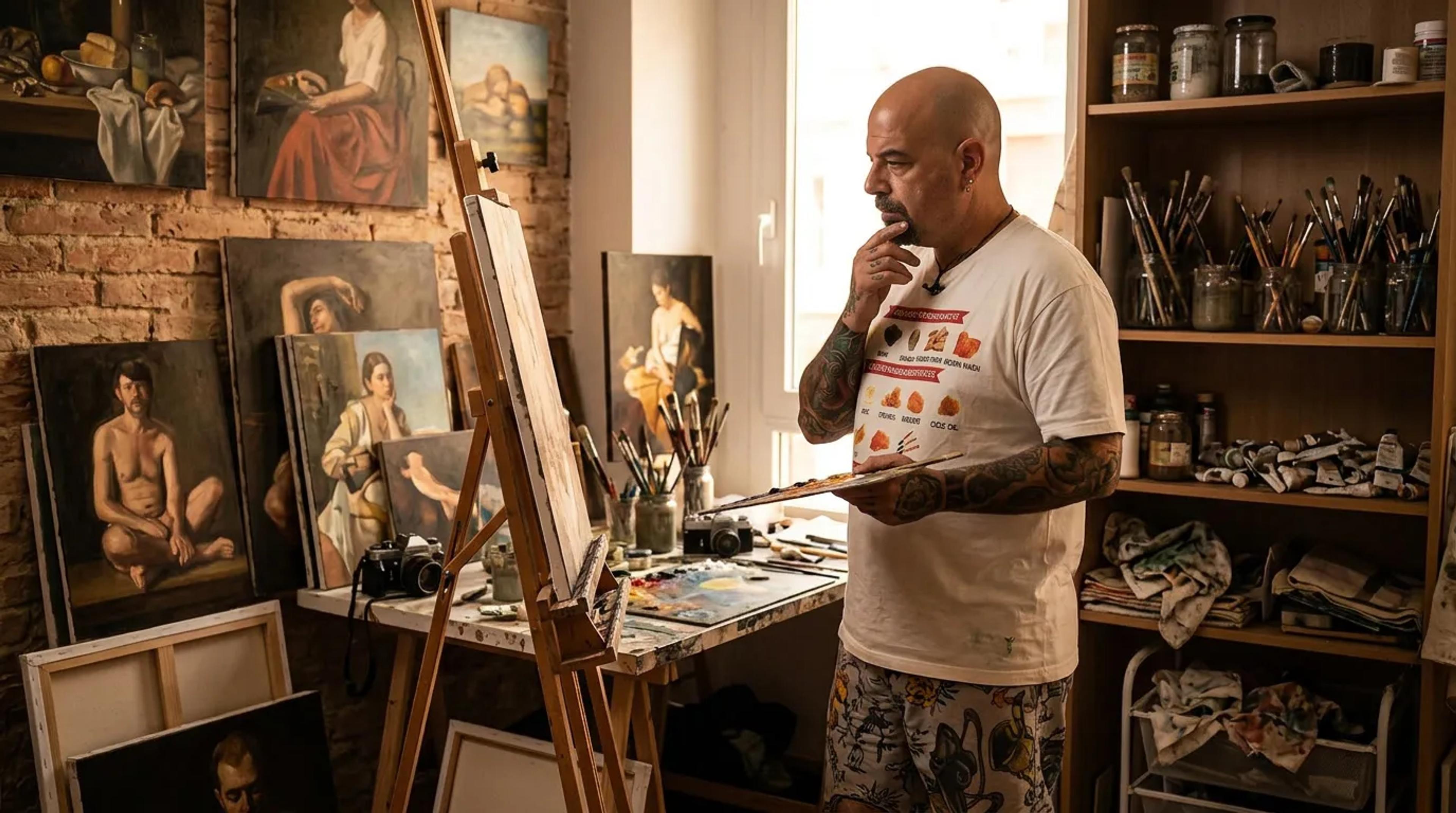
People ask what an artist does between commissions and shows. The honest answer is that the work made in those gaps is usually the work that matters most.
The space between
Commissioned work comes with expectations. A size, a palette, someone else's vision to honor. That's a real collaboration and I love it. But the work made in the gaps is pure exploration. No brief, no deadline, no compromise. That's where the next series usually starts.
The studio as a laboratory
Between projects the studio turns into a lab. New materials get tested. Techniques get pushed until they break. Color combinations that probably won't work get tried anyway, and sometimes the failure is more interesting than the success. That's where the breakthrough that defines the next year of work tends to come from.
Happy accidents
A lot of the strongest pieces start with an accident. A spilled jar of medium. An unexpected reaction between two paints. A surface that cracks in a way I'd never plan for. The studio is set up to let these accidents happen and to catch them when they do. That's most of the job.
One body of work
Every piece I make in the studio, even the ones that don't sell, feeds the larger body of work. Ideas thread through paintings made months apart. A color discovered in one experiment becomes the foundation for a whole series. Nothing is wasted, even the messes.
The rhythm of making
There's a rhythm to studio life that nobody talks about. Hours of setup and material prep. A few bursts of intense painting. Long stretches of just looking. The creative process isn't a straight line. It spirals, doubles back, and occasionally leaps forward when you weren't even ready.
That's the part of the work most people don't see. It's also the part I wouldn't trade.
Frequently Asked Questions
It depends on the piece. A small mixed media work might take a few days. A large layered piece can take weeks, partly because of drying and curing time between layers.
Yes. Personal studio work and commissions usually run in parallel. The two feed each other. Ideas tested in personal work often end up shaping commission pieces, and vice versa.
Some get painted over and become the base layer for a new piece. Others get cut up and used as collage material. Very few go in the bin. Failed paintings are often the most useful raw material in the studio.
The commission page on this site walks through the process. Short version: we talk about size, mood, color, and where the piece is going to live, you get a quote, and once you're in, the studio work begins.
Explore These Pieces
About the Author
Fordee is a Los Angeles-born, Barcelona-based painter and mixed media artist. His work spans pop art, contemporary, abstract, and street art using acrylic, resin, gold foil, alcohol ink, spray paint, and mixed media on canvas, wood, and furniture. Every piece in the collection is a one-of-a-kind original, shipped worldwide from his Barcelona studio.
Keep Reading
 studio
Gold Foil, Resin, and Why Surface Matters in Original Art
A flat painting and a resin-and-foil piece can be the same image. They're not the same object. The surface is the reason.
 studio
Mixed Media on Furniture: Why I Paint Cabinets, Doors, and Tables
Furniture isn't just a surface for paint. It's a piece of someone's life that becomes art and still has a job to do.
- studio
Inside a Pop Art Piece: From Blank Canvas to Final Resin Layer
People ask how a pop art piece actually gets made. Here's the full process from sketch to resin on a single piece, mistakes and all.
Inspired by what you see?
Explore the full collection of original artwork, prints, and more.
Browse the Collection